
New Antibody–Drug Conjugate (ADC) Study Utilizes Eagle Biosciences’ DM1 ADC ELISA Assay Kit


Antibody-drug conjugates (ADCs) are a new type of targeted therapy which are very promising in cancer treatment that significantly increase target specificity as well as reduce toxcity. ADCs are cell specific monoclonal antibodies that are conjugated with highly potent cyotoxics though a specific linker that help to deliver and release the drug inside the tumor cell. 

A recent study published in Molecular Cancer Therapeutics focused on evaluating the therapeutic potential of a new Antibody-drug conjugate (ADC), SYD985.  SYD985 is a HER2-targeting antibody–drug conjugate (ADC) based on trastuzumab and vc-seco-DUBA. The purpose of this research was to evaluate the therapeutic potential of
this new ADC f
or treatment of
patients with breast cancer.
This evauation was accomplished by comparing its preclinical antitumor
activity directly to that of T-DM1 in a series of high and low
HER2-expressing breast cancer PDX models. 

The promise of ADCs as a new class of drugs in
oncology is evident in the high number of ADCs that are currently in clinical development and even more that are in preclinical
programs and studies. Read More


Related Kits:

MMAE Antibody Drug Conjugate (ADC) ELISA Assay Kit

MMAF Antibody Drug Conjugate (ADC) ELISA Assay Kit

DM1 Antibody Drug Conjugate (ADC) ELISA Assay Kit



Phosphate Food Addivites: Reasons for Concern that they are Not on Food Labels


A study is in the works at Northwestern University focused on the additives in processed food, particularly phosphates and their impact on the heart. They have described phosphates as an additive that is so under the radar that it is actually not even listed on food labels. The American Heart Association (AHA) has teamed up with a new Northwestern Medicine research center to investigate the effects of these phosphate additives further in a population with higher rates of cardiovascular disease and who also consume more processed foods.

This research will be an extension of another Northwestern research already linking a high-phosphate diet to an increase of a hormone, fibroblast growth factor 23(FGF23), that strongl predicts risk of heart failure and death. Consumption of large amounts of phosphates causes the bones in your body to produce more FGF23 which thereby assists the body to excrete the excess phosphate through its action on the kidneys. If this process continues due to this poor diet rich in processed food, FGF23 may cause the walls of the heart’s main pumping chamber to thicken and stiffen which is called left ventricular hypertrophy. This creates a detrimental domino affect leading to heart failure. Read More

Related Kits:

FGF23 (C-Terminal) ELISA Assay Kit

FGF Basic (FGF-2) ELISA KIT

Bone Metabolism Assay Kits

Related News:

New Drug Target to Increase Bone Formation and Treat Multiple Diseases

EagleBio’s FGF23 (C-terminal) ELISA: Product Highlights

January 2015: Eagle Biosciences Introduces New FGF23(C-Terminal) ELISA Assay


Scientists at Imperial College London were performing a series of testing including sequencing the DNA of a morbidly obese young woman and some members of her family.This woman had an increased appetite which lead to major weight issues stemming from childhood. In addition, she had type 2 diabetes, learning difficulties, and reproductive problems. 

Based on the DNA sequencing, researchers found that this subject had inherited two copies of a harmful genetic change that meant she could not make a protein called carboxypeptidase-E (CPE). CPE is an enzyme responsible for the proper functioning of several hormones and brain transmitters controlling appetite, insulin, and other hormones important in the reproductive system. This clearly was a interesting finding that would explain the conditions and symptoms that the woman had been afflicted with her whole life.  

Previous studies have revealed that there are over 30 genes with harmful changes in DNA that cause extreme obesity.  Furthermore, there are several genes that when altered can cause type 2 diabetes as researchers have seen in this PLOS One study by NIHR Imperial Biomedical Research Centre and Diabetes UK. 

Genetic testing for obese individuals is important because it can provide patients with a diagnosis. It can also enable doctors to assist patients in providing genetic advice to family members as well as help them to obtain the best and most appropriate treatment.

In conclusion, diseases like this one are a recessive condition caused by inheriting an altered genetic sequence from both parents. This subject’s, parents were cousins so they most definitely had a higher chance to inherit the same genetic change from both parents. Read More

image above from www.sciencedaily.com

Related Kits:

Anti-ZnT8 (Zinc Transporter 8) ELISA

Insulin ELISA Assay Kit

ICA (Islet Cell Antibody) screen ELISA Assay Kit

Insulin Ultrasensitive ELISA Assay Kit


Related News:

New Study Utilizing EagleBio’s Human Adiponectin ELISA Assay Kit

New Hormone Discovery: Could it Lead to Ground Breaking Therapy for Type 2 Diabetes?

External Bionic Pancreas Device Brings Hope to Diabetics.

Eagle Biosciences Introduces Anti-Zinc Transporter 8 ELISA

Sensitivity of Islet Cell Antibodies (ICA) ELISA Compared with Indirect Immunofluorescence Assay

New Study Utilizing EagleBio’s  Human Adiponectin ELISA Assay Kit


EagleBio is pleased to share a recent publication below referencing the use of our Human Adiponectin ELISA Assay Kit. This Adiponectin ELISA Kit  is a quick, simple, and sensitive assay for the quantitative determination of  human adiponectin in human serum and plasma. This assay is a part of our Endocrine Assay Kit Line, a line that offers a comprehensive product grouping of unique and for measuring a variety of analytes for diabetes and obesity research.  


Publication Citing EagleBio’s Human Adiponectin ELISA Assay Kit:

Effect of coenzyme Q10 on glycaemic control, oxidative stress and adiponectin in type 2 diabetes

Summary:

This study was planned to investigate the effect of coenzyme Q10 (CoQ10) supplementation on glycaemic control, oxidative stress (OS), and adiponectin levels in type 2 diabetic (T2DM) patients. It is the first study on diabetic patients focused on evaluating the effect of CoQ10 on adiponectin levels.

In conclusion, after eight weeks of supplementation with CoQ10 , it may reduce OS in T2DM patients but it may not change glycaemic control and adiponectin levels. In order to confirm this effect, further investigations with larger populations and longer periods are required.


Related Kits:

Human Adiponectin ELISA Assay Kit

Mouse Adiponectin ELISA Assay Kit

Rat Adiponectin ELISA Assay Kit

Resistin ELISA Assay Kit

Endocrine Assay Kits


Related News:

Mediagnost Introduces Eagle Biosciences as Distributor in North America

New Hormone Discovery: Could it Lead to Ground Breaking Therapy for Type 2 Diabetes?

Sensitivity of Islet Cell Antibodies (ICA) ELISA Compared with Indirect Immunofluorescence Assay

External Bionic Pancreas Device Brings Hope to Diabetics.

Eagle Biosciences Introduces Anti-Zinc Transporter 8 ELISA


Foot infected with septicemic  plague

A teen died recently of the Septicemic plague which is serious illness that occurs when the the bacterium Yersinia pestis enter the bloodstream directly and spreads throughout the body. Yersinia pestis was responsible for killing millions of people in the 1300s in Europe, in a pandemic known as the Black Death.  This bacteria is carried by rodents such as rats, ground squirrels, and prairie dogs (and their fleas) and is prevalent in the western United States. 

The young man of 16 years old who contracted this disease,Taylor Gaes was the first person in Larimer County to get the plague since 1999. There is a an active investigation to determine how he was infected but they believe he may have been bit by infected fleas on his family’s property.  

Unfortunately, the symptoms of the plague can present like the flu, thus they are often misinterpreted which was the case for Taylor. After a few days of being ill, he began coughing up blood and was rushed to the hospital but he died before arriving there. Read More


Routes of Contraction of the Plague:

  • Bite from infected fleas
  • Contact with an infected animal such family pet, rodents, etc.
  • Inhalation of airborne droplets from an infected person or animal (especially cats)
  • Exposure to the bacteria in a laboratory

Symptoms:

Symptoms appear 2 to 6 days after exposure to plague bacteria.

  • Swollen Lymph nodes
  • Headache
  • Fever
  • Chills
  • Fatigue
  • Gastrointestinal Symptoms
  • Extreme Weakness
  • Shock
  • Bleeding into the skin and other organs

Click Here for more signs, symptoms, facts, and prevention tips on the plague.


image above from www.livescience.com

June 2015: Eagle Biosciences, Inc. is pleased to announce a North American
distribution agreement with Mediagnost in Germany. Mediagnost offers a wide
range of top-notch biotechnology services and products which include test
systems for multiple applications. They have a unique focus on the advancement
of Hepatitis A vaccine and the development of endocrine testing methods. Mediagnost’s core research and development projects
encompass the areas of infectious diseases, endocrinology, and neurology.

“I am
thrilled to bring Mediagnost products to EagleBio and add them to our product
offerings.” said Dan Keefe, President of Eagle Biosciences. He continued, “This
certainly is a great opportunity for Eagle as we are establishing a new
strategic partnership with a group of scientific experts that are constantly
driving forward the identification of innovative biomarkers.”

This
product is currently for research use only. Visit the Eagle our website www.EagleBio.com or call 866-411-8023 for full details.


Related Kits:

Human Adiponectin ELISA Assay Kit

Mouse Adiponectin ELISA Assay Kit

Rat Adiponectin ELISA Assay Kit

Resistin ELISA Assay Kit

Endocrine Assay Kits

Related News:

New Hormone Discovery: Could it Lead to Ground Breaking Therapy for Type 2 Diabetes?

Sensitivity of Islet Cell Antibodies (ICA) ELISA Compared with Indirect Immunofluorescence Assay

External Bionic Pancreas Device Brings Hope to Diabetics.

Eagle Biosciences Introduces Anti-Zinc Transporter 8 ELISA

New Drug Target to Increase Bone Formation and Treat Multiple Diseases


Recent research at the Scripps Research Institute focused on developing a new drug by investigating a protein known as PPARG (known as the master regulator of fat) and how it can affect the stem cells of the bone marrow.The team of scientists in the Translational Research Institute at Scripps has designed a compound called SR2595 to be used it to repress the PPARG protein. Their studies revealed that by reducing PPARG, they were able to promote bone formation by inducing the formation of osteoblasts (cells that help bone tissue to form).  

PPARG’s close relation to several proteins with known roles in disease provides hope for endless therapeutic opportunities. This is a ground-breaking discovery because this drug target not only could treat and possibly cure numerous bone-related diseases, but it also has enormous potential to treat a variety of other diseases. Read More

Related Kits:

Bone Metabolism Assay Kits

Related News:

EagleBio’s FGF23 (C-terminal) ELISA: Product Highlights

January 2015: Eagle Biosciences Introduces New FGF23(C-Terminal) ELISA Assay


30% Discount on our:


Total Complement Functional Screen ELISA

Complement Classical Pathway ELISA

Complement Alternative Pathway ELISA

Complement MBL Pathway ELISA

This promotion is good through July 31st, just use code below when ordering.

PROMOTIONAL CODE: COMP0731


Related Products:

Immunology Assay Kits


Related News:

EagleBio Spotlight: Complement System

The complement system is a crucial part of the immune system which assists antibodies and phagocytic cells to clear pathogens from an organism. It is an elaborate protein network of effectors, inhibitors and regulators that is the driving force for critical processes involving overall health as well as disease states. This system continuously communicates with associated physiological pathways such as immunity, inflamm­­ation, homeostasis, and development.

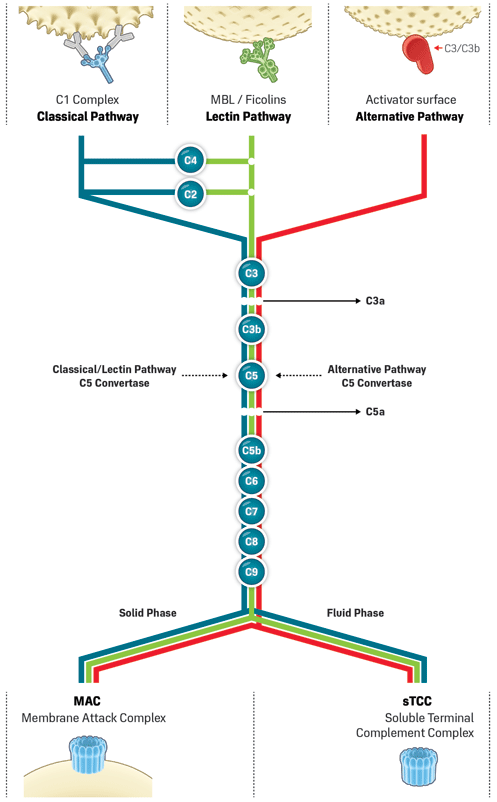
The complement system is made up of over 50 plasma and membrane-bound proteins that interact in a cascade fashion. There are three key biochemical pathways that trigger the complement system: the classical pathway, the alternative pathway, and the lectin pathway. These pathways trigger the generation of biologically active molecules that play crucial roles in numerous physiological and pathological processes as mentioned above.

Classical Pathway: the pathway activated by C1 binding either directly to bacterial surfaces or to antibody for the purpose of identifying and flagging bacteria as foreign.

Alternative Pathway: the pathway activated by the binding of complement protein C3b to the surface of a pathogen. This pathway is a key component of innate immunity and has a role in boosting the work of classical pathway.

Lectin Pathway: the pathway activated by binding of MBL (mannose-binding lectin) to mannose residues on the pathogen surface. 


Figure 1: Complement Overview

Figure 1: Complement Overview


Reasons for Measuring the Complement System:

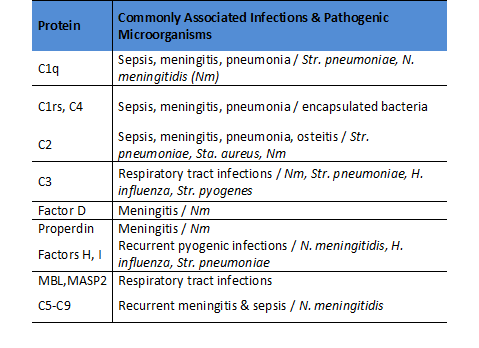
The complement system plays intricate and vital roles in both the innate and the adaptive immune defense and it is acts a bridge between these two facets of immunity. Complement deficiencies and other molecular abnormalities in this system result in increased infection and increased risk for autoimmune and numerous other diseases. The increased awareness and interest in the complement system has prompted the need for a simple, objective, and effective method to assess the function of complement activity. Measuring various parts of the complement pathway gives insights to researchers for various disease states as well as for potential therapeutic targets.  


Table
1: Complement Deficiencies and Associated
Infections (Skattum et. al)


References and Relevant Publications:

2. Janeway, CA Jr et al. “The complement system and innate immunity”. Immunobiology: The Immune System in Health and Disease. New York: Garland Science

3. Roos, Anja et. al. “Evaluation of Complement Function by ELISA.” Methods in Molecular Biology 2014; 1100. 

4. Skattum L et al. “Complement deficiency states and associated infections.” Mol Immunol 2011;48:1643-1655.

5. Yang, Kun, et. al. “CMAP: Complement Map Database.” Bioinformatics. 2013 Jul 15; 29(14): 1832–1833.


Related Kits:

Total Complement Functional Screen ELISA
Complement Classical Pathway ELISA
Complement Alternative Pathway ELISA
Complement MBL Pathway ELISA
Immunology Assay Kits