
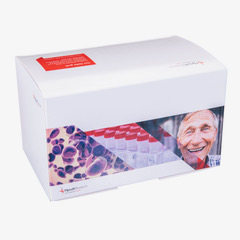

RNase 7 ELISA Kit
Antimicrobial proteins (AMPs) are an essential component of the body’s first line of defense against pathogens. These small, endogenous cationic molecules are produced by phagocytic and epithelial cells and provide broad-spectrum antimicrobial activity against Gram-positive and Gram-negative bacteria, viruses, yeasts, and fungi. AMPs contribute to both innate and adaptive immunity through direct microbial inactivation and immunomodulatory functions, including the regulation of leukocyte migration. RNase 7 is a secreted antimicrobial protein belonging to the RNase A superfamily and is expressed by various epithelial tissues. It is an approximately 14.5 kDa protein with ribonuclease activity, characterized by conserved cysteine residues and catalytic histidine and lysine residues. However, its antimicrobial activity is independent of its ribonuclease function. RNase 7 is considered one of the most potent antimicrobial peptides on a molar basis and contributes to the protection of epithelial barriers, particularly in the skin and urinary tract. Its antimicrobial activity is associated with its ability to bind and disrupt microbial cell membranes, a process supported by clusters of positively charged lysine residues. RNase 7 can also bind bacterial components such as lipopolysaccharides (LPS) and peptidoglycans.
In research settings, RNase 7 measurement is used to investigate epithelial antimicrobial defense, innate immune responses, and host-pathogen interactions. Researchers study its role in controlling microbial growth on epithelial surfaces, particularly in the skin, kidneys, and urinary tract. In the urinary system, RNase 7 is constitutively expressed by intercalated cells in the renal collecting tubules and is secreted into urine at concentrations that contribute to baseline antibacterial protection. In the skin, it helps regulate microbial colonization, and its expression can increase in response to pro-inflammatory cytokines. RNase 7 expression has also been investigated in ocular surface immunity, where signaling pathways involving mitogen-activated protein kinases (MAPKs), rather than NF-κB, have been implicated in its regulation. Interleukin-1 beta (IL-1β) has also been shown to stimulate RNase 7 expression.
In clinical research, RNase 7 is investigated as a potential biomarker of epithelial immune defense and antimicrobial activity, particularly in urinary tract infections, kidney-related inflammatory conditions, and skin disorders. Changes in RNase 7 expression or concentration may provide insight into epithelial barrier function, local inflammatory responses, and susceptibility to microbial colonization. Its constitutive presence in the urinary tract and inducible expression in response to inflammatory signals make it particularly relevant to studies of urinary and epithelial infections. However, RNase 7 levels should be interpreted alongside other antimicrobial and inflammatory biomarkers, as changes may reflect both infection-related and noninfectious inflammatory processes.
This RNase 7 ELISA Kit is manufactured in Netherlands by Hycult Biotech.
Related products