
Ficolin-3 ELISA Kit
Ficolins are a family of pattern-recognition proteins characterized by a collagen-like domain and a fibrinogen-like recognition domain. Three forms have been identified in humans: Ficolin-1 (M-ficolin), Ficolin-2 (L-ficolin), and Ficolin-3 (H-ficolin or Hakata antigen). Ficolin-3 consists of a collagen-like region and C-terminal recognition domains that bind acetylated structures on microbial surfaces, including N-acetylglucosamine (GlcNAc) and N-acetylgalactosamine (GalNAc). It is produced primarily by the liver, from which it is secreted into the circulation, and is also expressed in the lungs. Similar to mannose-binding lectin (MBL) and Ficolin-2, Ficolin-3 associates with MBL-associated serine proteases, particularly MASP-2, to initiate the lectin pathway of complement activation. Following recognition and binding of microbial surfaces, MASP-2 cleaves complement components C4 and C2, generating the C3 convertase C4b2a. This initiates downstream complement activation, promoting pathogen opsonization, inflammatory cell recruitment, and, in some cases, complement-mediated lysis.
In research settings, Ficolin-3 is investigated for its role in innate immune recognition, complement activation, and the clearance of damaged or dying cells. Studies have demonstrated that Ficolin-3 binds to late apoptotic cells and shows strong, uniform binding to necrotic cells. Its recognition of these cell populations differs from that of MBL and Ficolin-2, suggesting distinct roles in the recognition and removal of cellular debris. Binding of Ficolin-3 to late apoptotic cells has also been shown to enhance their adhesion to and uptake by macrophages, highlighting its potential contribution to the clearance of dying cells and the regulation of inflammatory responses.
In clinical research, Ficolin-3 has been investigated in relation to autoimmune conditions and liver disease. Circulating concentrations are generally stable, with a reported mean serum concentration of approximately 15 µg/mL. In a large population study, Ficolin-3 was detected in nearly all individuals tested, although approximately 5% of patients with systemic lupus erythematosus (SLE) were reported to lack detectable Ficolin-3, potentially due to anti-Ficolin-3 autoantibodies. Ficolin-3 was detected in patients with other autoimmune diseases included in the study. In liver disease, serum concentrations have been reported to decrease with increasing severity of cirrhosis, suggesting a possible relationship with hepatic function. Measurement of Ficolin-3 may therefore support research into lectin pathway regulation, autoimmune responses, and liver disease; however, its concentration alone does not establish complement pathway functionality or provide a definitive diagnosis.
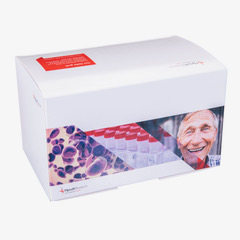
This Ficolin-3 ELISA Kit is manufactured in Netherlands by Hycult Biotech.
| Size | |
| Sensitivity | 8 ng/mL |
| Dynamic Range | 8 – 500 ng/mL |
| Incubation Time | 3 hours 30 minutes |
| Sample Type | Serum, Plasma, Cell Culture Supernatant |
| Storage | 2-8°C |
| Alternative Names | H-ficolin 3 |
Related products