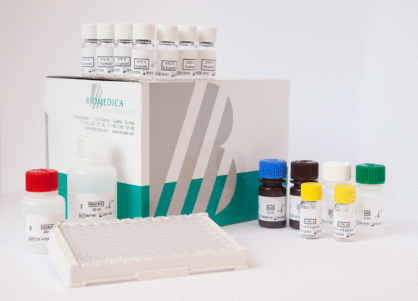

Anti-Human Tissue Transglutaminase (anti-tTG) IgG ELISA Kit
Anti-Human Tissue Transglutaminase (anti-tTG) IgG antibodies are autoantibodies directed against tissue transglutaminase, an enzyme involved in deamidating gluten peptides in the small intestine. Unlike the IgA isotype, anti-tTG IgG is particularly important in patients with selective IgA deficiency, a condition more common in celiac disease (CD) populations, where IgA-based tests may yield false-negative results. Anti-tTG IgG reflects an immune response to gluten and associated intestinal autoimmunity, leading to villus atrophy, malabsorption, and systemic manifestations.
In the clinical setting, anti-tTG IgG ELISA is used for screening and diagnosis of celiac disease in patients who are IgA deficient or when IgA results are inconclusive. It is also useful for monitoring adherence to a gluten-free diet, as antibody levels decrease with effective gluten exclusion. Quantitative ELISA provides titer measurements, which can correlate with disease activity and response to dietary intervention, making it a valuable tool for both initial assessment and follow-up.
In research, anti-tTG IgG serves as a biomarker for studying gluten-driven immune responses, non-IgA celiac disease, and early-stage autoimmunity. It is frequently employed in epidemiologic studies to identify undiagnosed celiac disease in populations with higher rates of IgA deficiency. Additionally, anti-tTG IgG ELISA is used in clinical trials and mechanistic studies to evaluate the efficacy of therapeutic interventions, explore the immunopathogenesis of celiac disease, and assess immune tolerance to gluten.
This Anti-Human Tissue Transglutaminase (anti-tTG) IgG ELISA Kit is manufactured in Germany by Medipan GmbH.
Related products